Editor note: This article was originally published on the Italian Institute for International Studies.
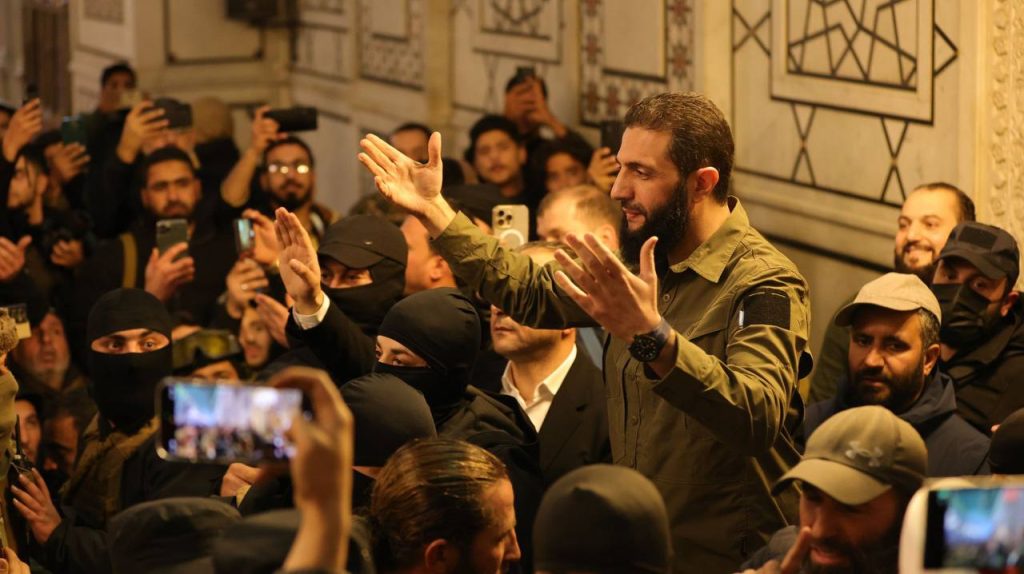
The Islamist organization in power today in Damascus, Hay’at Tahrir al Sham, is grappling with the management of power and the unification of a country divided and torn apart by years of civil war. After having led a lightning advance against the Assad regime, starting from the governorate of Idlib where it had been confined for the last ten years or so and heading for the capital at the beginning of December 2024, it has completely changed its narrative from jihadism to ruling Islamism. A gradual and fundamentally pragmatic change that has the objective of maintaining power. The challenge of HTS is now to include all the components in the new Syria without distinctions between men and women, language and religion. A challenge that the leadership of the organization seems to have pragmatically accepted, but which still needs to be completely accepted by the base of the movement.
Jabhat al-Nusra’s Islamist narrative: lurching between ISIS and al-Qaeda
Hay’at Tahrir al-Sham (HTS), formerly known as Jabhat al-Nusra, has undergone significant ideological, organizational, and alliance transformations since its foundation in 2012. This evolution occurred gradually, even during its affiliations with the Islamic State in Iraq and Al Qaeda, where its narrative remained distinct. Initially, when it was part of the Islamic State in Iraq (2012-April 2013), its approach was markedly less extreme than ISIS’s. Al-Nusra aimed to mobilize regional fighters to challenge Bashar al-Assad’s regime rather than to govern. Nevertheless, the group attracted thousands of foreign fighters into its ranks, especially in its early stage. The group focused on supporting fellow Muslims in Syria, without displaying ambitions to rule. During this period, it also sought to forge connections and alliances with local factions and civilians, positioning itself primarily as a movement dedicated to fighting the Syrian regime and its allies.
In April 2013, Jabhat al-Nusra severed ties with the Islamic State in Iraq and aligned itself with al-Qaeda Central, led by Ayman al-Zawahiri. Contrary to expectations that the group would adopt a less extreme stance given al-Qaeda’s relatively moderated approach compared to the Islamic State in Iraq, Jabhat al-Nusra entered a more radical phase. This shift was largely due to defections by hundreds of foreign fighters who perceived the group’s leader, Abu Mohammad al-Jawlani (later known as Ahmed Al Sharaa, the self-appointed Syrian President), as too lenient. These fighters believed that the Islamic State in Iraq was more aligned with their views, leading to their departure.
To counteract this perception and retain his fighters, al-Jawlani sought to reaffirm Jabhat al-Nusra’s commitment to the Salafi jihadi cause, demonstrating that the group remained resolute and formidable. This period of competitive radicalization is exemplified by a 2015 incident where Shadi al-Waysu, then a judge and now the Minister of Justice under HTS, was filmed supervising public executions of women, underscoring the group’s hardened stance. Despite these actions, the group was internally conflicted about its direction. While it aimed to project strength and adherence to the Salafi jihadi cause to its members and enemies, it also sought to integrate and show solidarity with the local communities it was part of. Thus, during this period, Jabhat al-Nusra grappled with conflicting narratives about its identity and goals.
By 2016, Jabhat al-Nusra realized the high cost of its association with al-Qaeda and consequently severed ties. The group’s public discourse shifted from al-Qaeda’s global agenda to a more localized focus. They began to eliminate phrases with global connotations like “Jihad against the West” or “Jihad against secular states,” replacing them with terms emphasizing their focus on Syria, albeit with an Islamist orientation. This change was symbolically marked by their adoption of the Syrian revolutionary flag, modified only by adding the shahada, the Islamic declaration of faith. The initial signs of change emerged in 2016 when al-Jawlani publicly revealed his face for the first time. Until then, his identity had been concealed, known only by his voice. In this pivotal moment, he announced the severance of ties with al-Qaeda and declared that the group would no longer align with external organizations. This marked the beginning of a shift towards pragmatic moderation. By 2017, the leadership made concerted efforts to blend the Islamist elements of the group with a stronger nationalist focus, emphasizing their commitment solely to Syria.
HTS in power, and jihadism?
When Jabhat al-Nusra broke ties with al-Qaeda and rebranded as Jabhat Fateh al-Sham in 2016, it faced internal resistance from pro-al-Qaeda members within the group. Most of these members defected and formed Hurras al-Din, which remained affiliated with al-Qaeda in Syria. Although Hurras al-Din announced its dissolution last month, it had effectively ceased to exist in 2020 after HTS cracked down on it and shut down its military bases. Driven by a desire to survive and dominate northwest Syria, al-Jolani sought to merge with other local factions to integrate his group within the local Islamist opposition. This effort resulted in the formation of Hay’at Tahrir al-Sham (HTS) in 2017, a merger that included Jabhat Fateh al-Sham, Liwa al-Haqq, Army of the Sunna, Ansar al-Din, and Nur al-Din al-Zenki Movement. Some of these factions later defected from HTS, prompting the group to either dismantle or weaken them.
By 2017, HTS began promoting the concept of al-Kayan al-Sunni, or the Sunni entity, encapsulating the group’s narrative as the protector of Sunnis in Syria against the Alawite regime and its allies. This narrative remained largely unchanged until December 2024, when HTS advanced towards Damascus. During this operation, a radical shift occurred in their discourse, moving away from the notion of a Sunni entity to embrace a more inclusive slogan, “Syria for all Syrians.” This marked a significant change in their Islamist narrative as they approached the capital.
Currently the HTS’s state narrative talks about protecting all Syrians, regardless of their gender (here we mean men and women) or sect, which reflects its leadership’s high sense of pragmatic adaptability. The leadership’s goal is to stabilize and solidify its power to ensure continued governance. Al-Sharaa is prepared to do whatever is necessary to achieve this, including engaging with minorities and forming a nominally inclusive government. This transition from a radical past to a more moderate position has not been smooth or complete. The leadership has responded to dissent within its ranks—those adhering to extreme and violent radicalism—by expelling, imprisoning, or executing them.
The transformation within HTS was implemented through a top-down approach, with the leadership mandating a new direction and gradually enforcing it among its followers. The group has acknowledged its previous extremist behavior, positioning these actions as part of a past phase in its trajectory and implying a move away from such practices. For instance, when a 2015 video featuring the current Minister of Justice resurfaced and went viral recently, HTS confirmed its authenticity but emphasized that the actions were part of their history, without explicitly condemning them. Significantly, the minister involved was not removed from his position.
The challenge within HTS primarily lies in the relationship between its leadership and the organization’s base—its fighters and rank-and-file members—who have experienced the shift from the global jihadism of ISIS and AQ into to a governance-oriented Islamism. Until November 27, 2024, HTS publicly positioned itself as a defender of Sunni Islam, focusing on protecting the Sunni entity in Idlib. However, as they expanded their control into regions of Syria previously held by Assad, the leadership began advocating on behalf of all Syrians, shifting to a more inclusive rhetoric.This abrupt change in narrative presents a significant adjustment for the rank-and-file, who have been indoctrinated for years with the ideology of protecting Sunni identity. This transition may be challenging for fighters used to a narrower, sectarian viewpoint. Moreover, many HTS fighters, having never left the conservative environment of Idlib, are now encountering less conservative communities in Damascus. These new interactions could potentially foster deeper social changes within Syrian society, as human relationships evolve and influence perspectives and behaviours.
Broadly, Dyrendal (2020) describes three kinds of dynamics that can be used to describe the relationships between conspiracy theories and religion:
a) conspiracy theories in religion,
b) conspiracy theory as religion, and
c) conspiracy theories about religion.
The first one (conspiracy theories in religion) deals “with different sets of conspiracy beliefs ideologically attuned to the particular religious group and circumstance”, the second (conspiracy theory as religion) “centres on the philosophical and psychological underpinnings of ideation”, and the last (conspiracy theories about religion) “focuses on ingroup/outgroup dynamics in complex socio-political situations” (Ibid, 371).
Conspiracy theories in religion relate mostly to authority and power, since they are usually employed to delegitimize those that are seen as enemies. Of course, different religions have different power structures, and this will affect their dynamics with conspiracy theories. The latter can be “used both from the top down (by those in power) and from the bottom up (by the powerless and to criticise power)” (Önnerfors 2021: 26), in a way that more marginalised religions frequently use conspiracy theories as a language of opposition while heterodox or mainstream religions use them as a language of counter-subversion (Dyrendal 2020: 381).
An example of this was the case of the Brazilian Senator Damares Alves who detailed, during an evangelical worship in 2022, a conspiracy involving sexual child slaves, following the style of QAnon. As Pastor, Damares Alves publicly described (in horrifying detail) the workings of this supposed case of sexual abuse of children in the Island of Marajó, Northeastern Brazil. The conspiracy theory she chronicled during the worship was immediately followed by a discourse regarding how the then-President Jair Bolsonaro was the only one fighting to end such activities. The Pastor/Senator stated: “The war against Bolsonaro, which the press has raised, which the Supreme Court has raised, which Congress has raised, believe me, is not a political war. It is a spiritual war.” (Duchiade 2022, translated by the author). What is possible to see in this case was the wielding of religious sensibilities in the service of political interests through the direct application of a conspiracy theory. The Church’s role “as guardian of threatened, traditional values in the face of internal and external threats is a common conspiracy trope, and its role as violated victim of evil a common trope of the culture wars” (Dyrendal 2020: 376). The interests of the Brazilian Evangelical Church, represented by Pastor Damares Alves, became intertwined with the interests of Bolsonaro’s political party. The Church was thus “playing a supporting role in the symbolic assertion” (Ibid, 377) of Bolsonaro as president.
Nevertheless, it’s important to note that “religion does not play a simple, unified role” (Ibid, 381), in a way that when faced with such cases, we must always ask “who speaks, in what context and for which interests, as well as about what authority they claim” (Dyrendal 2020: 381). Damares Alves does not speak for all evangelicals in Brazil, but it is unquestionable that her spread of this conspiracy theory had an effect over a considerable portion of the nation.
It is also important to highlight that “religious adherence does not necessarily predict specific conspiracy beliefs one way or the other” (Ibid, 375). In fact, there are examples of religious leaders helping to combat anti-vaccination campaigns by providing “theological arguments for vaccines being acceptable”, including the “production of halal-certified vaccines”, showing how religious authority was adopted “to oppose the crisis narrative the conspiracy theory presented” (Ibid, 378) – an example of how conspiracy theories in religion can have positive outcomes. It is still possible to state that “some types of religion seem to have a higher, more general propensity towards conspiracy beliefs than others”, which is the case with fundamentalist groups, who are “more likely to have apocalyptic expectations” and Manicheist views (Ibid, 375).
More specifically, ‘fundamentalism’ is here understood as a modern ideology, measure, or action that is reactionary towards modern developments (rejects current liberal ethics, science, or technology) and is based on a historical narrative presented in terms of cosmic dualism, that is, the notion of paradise and a fall from it (adapted from Peels 2023: 743).
On a similar note, it is possible to argue that New Age religions/spirituality are also shown to feature “overlaps with belief in conspiracy theories – so-called ‘conspirituality’” (Önnerfors 2021: 29). Conspirituality refers to a politico-spiritual philosophy based on convictions that, although religious/spiritual in nature, are presented in the form of a conspiracy theory, where: the social order is secretly controlled by an unenlightened group of people and the only salvation is in the ‘paradigm shift in consciousness’ that will promote an awakened worldview (adapted from Demuru 2022). In these cases, we are dealing with conspiracy theory as religion.
Serving “either to consolidate or destabilise power relationships, depending on who has conjured them and in what context”, modern conspiracy theories substitute “previous conceptions of divine will or fate”, situating “the agency and power to intervene in human affairs within the realm of pre-political or pre-social order, or within hidden human (sometimes alien) dimensions of organised darkness and invisibility where they develop and unfold their force” (Önnerfors & Krouwel 2021: 259). In other words, “by giving the impression of being scientific while at the same time providing answers to existential questions (without explaining them in purely religious terms),” conspiracy theories “can thus be regarded as part of the political religion within a more secular society”, being “more easily accepted by people who do not define themselves as religious” (Önnerfors 2021: 29).
This view of conspiracy theory as religion thus regards the idea that the former is replacing the later by exerting its functions in a now more secularized society. However, this notion can be questioned, since it is first of all not possible to state that we have more conspiracy theories today than during a time when religious adherence was supposedly stronger, and also because “religion is usually not negatively correlated with conspiracy beliefs”, suggesting the two go hand-in-hand, rather than one replacing the other (Dyrendal 2020: 373). Instead of thinking of conspiracy theory as a substitute of religion, we may think of the ways in which conspiracy theory can be seen as a form of religion. In this regard, Ladini (2022: 34-35) suggests “caution when arguing about similarities between individual religiosity and conspiracy beliefs”, recommending “to always consider which dimensions of religiosity” are being accounted for “when analysing the association between the two concepts”. Dyrendal (2020: 373) suggests two main dimensions: the social and the epistemic. The epistemic regards the status of both religion and conspiracy theories as alternative/counter-knowledge, while the social is related to the how they both organise collective identities on the basis of in-group and out-group (Ibid).
According to Önnerfors (2021: 29), the narrative structure of conspiracy thinking “is closely related to myths, intuitive explanations of the world through reference to supernatural forces which have the power to intervene in and influence people’s lives”. As such, conspiracy theories “convey clearly religiously coded ideas about the dualistic battle between good and evil (theodicy) and ideas about Judgment Day (eschatology)” (Ibid). Additionally, both conspiracy theories and religion “present a worldview that is largely teleological, and they present parallel epistemologies that make claims ‘unfalsifiable’” (Dyrendal 2020: 372). Other cognitive factors that underlie both conspiracy and religious beliefs are “the proclivity to see intention as a cause”, as well as “increased holistic, intuitive, symbolic and magical thinking, which again correlate to an increase in the tendency towards seeing things as related in meaningful patterns” (Ibid, 375), and the “attribution of agency to hidden forces” (Ladini 2022: 35). In this sense, although I would not argue that conspiracy theories and religion are the same, it may be possible to see conspiracy theories as working in a similar way to that of religious belief systems, since they can both represent a “resource for understanding the world, for identity construction, for ordering social relations, and for gaining or disputing authority and power” (Dyrendal 2020: 380-381).
As for conspiracy theories about religion, I would like to highlight my case-study, the Eurabia conspiracy theory. Bergman (2021: 37) traces the origins of this narrative to “several influential publications” that “have warned of an Islamist conspiracy of occupying the West”. The first one pointed out by the author is the 1973 dystopian novel Le Camp des Saints by French writer Jean Raspail, which “depicts the cultural demise of Western civilisation through mass migration of sex-crazed Indians” (Ibid, 38). However, this “fear of cultural subversion is, though, only the first part of the full conspiracy theory”, whose “completion usually also takes the form of accusing a domestic elite of betraying the ‘good ordinary people’ into the hands of the external evil”. This core message was also prevalent in the book Eurabia – The Euro-Arab Axis by Giséle Littman, an influential text to the conspiracy theory which maintains that “ever since the early 1970s, the European Union was secretly conspiring with the Arab League to bring about a ‘Eurabia’ on the continent” (Ibid, 39). Additionally, the book While Europe Slept – How Radical Islam Is Destroying the West from Within by an American author called Bruce Bawer was also highlighted by Bergman, this time expanding the conspiracy
Similar to Eurabia, the Great Replacement became popular after the “deeply controversial French philosopher, Renaud Camus, used it for the title of his book published in 2011”, in which “he argued that European civilisation and identity was at risk of being subsumed by mass migration, especially from Muslim countries, and because of low birth rates among the native French people” (Ibid, 37). The conspiracy theory thus expands on this idea, stating that the predominantly white Christian population of Western countries is being progressively replaced by Muslims or other groups of migrants due to the secret orchestrations of malignant internal forces that seek the extinction of native populations (adapted from Krouwel & van Prooijen 2021; Bergmann 2021; Gualda 2021; Önnerfors 2021).
Generally, the Eurabia and The Great Replacement conspiracy theories have “often become entangled in a more general opposition to immigration” (Bergmann 2021: 40), connected to political statements of failed integration (Ekman 2022: 1128), that turn immigration into an ‘invasion’ that threatens people’s culture and identity. A different facet of this interpreted ‘invasion’ is reflected on the fears surrounding the fall in the birth rates of the European population, which is often referred to as ‘demographic suicide’ – the idea that Europe is “‘systematically depopulating itself’; meanwhile, Europe’s Muslims appear to be dreaming of filling this vacuum” (Gualda 2021: 60).
The Eurabia and related conspiracy theories have been among “the most fast-growing amongst Neo-Nationalists, rooting in countries like Austria, Denmark, Germany, Italy and the UK”, as well as the Netherlands and Belgium (Bergmann, 2021: 37). They have “progressed through all three waves of Neo-Nationalism” (Bergmann 2021: 48-49). During the first wave (the Oil Crisis of the 1970s), they “still only thrived on the periphery of European politics”, becoming “much more prominent in the second wave [(post-collapse of communism)], especially after the terrorist attacks on 11 September 2001”. However, it was in the third wave (the financial crisis of 2008), “that the Eurabia theory moved firmly into the mainstream, especially after the refugee crisis of 2015”, which “brought the Eurabia theory to new heights” (Ibid). Nowadays, it is common to find political leaders who propagate such conspiracy theories (Ekman 2022: 1127), which points to how “radicalization can be induced by state actors (especially those dependent upon electoral support mechanisms)” (Steiner & Önnerfors 2018: 12).
As such, radicalization, and its use of religious conspiracy theories (or conspiracy theories about religion) can be potentially seen as agenda setting, leading to a moment when a formerly radical position becomes normalized (Ibid, 21) – as is the case with the rapid swing to the right taken by western countries over the last decade. It has been pointed out how populists often “make use of various other conspiracy theories to persuade potential constituents into believing that they are the real outsiders able to fight back against the concerted machinations of the (political) establishment” (Harambam 2020: 3), when in fact they are frequently part of it. As formerly radicalized expressions get to the mainstream, the radical achieves the potential of its transformative power (Steiner & Önnerfors 2018). And the religious dimensions or aspects contained or instrumentalized in such conspiracy theories cannot be ignored.
REFERENCES
Bergmann, E. (2021). The Eurabia conspiracy theory. In: Önnerfors, A., & Krouwel, A. (Eds.), Europe: Continent of Conspiracies: Conspiracy Theories in and about Europe. Routledge, 36-53.
Coolsaet, R. (2024). The emergence and expansion of a contentious concept. In: Busher, J., Malkki, L., & Marsden, S. (Eds.), The Routledge Handbook on Radicalisation and Countering Radicalisation. Routledge, 34-52.
Dawson, L. L. (2024). Insights from the study of new religious movements into the process of radicalisation. In: Busher, J., Malkki, L., & Marsden, S. (Eds.), The Routledge Handbook on Radicalisation and Countering Radicalisation. Routledge, 132-149.
Demuru, P. (2022). Qanons, anti-vaxxers, and alternative health influencers: a cultural semiotic perspective on the links between conspiracy theories, spirituality, and wellness during the Covid-19 pandemic, Social Semiotics, 32:5, 588-605.
Duchiade, A. (2022, October 11). Suposto abuso sexual contra crianças citado por Damares circula como ficção na internet desde 2010. O Globo. https://oglobo.globo.com/blogs/sonar-a-escuta-das-redes/noticia/2022/10/suposta-violencia-infantil-citada-por-damares-circula-como-ficcao-na-internet-desde-2010.ghtml
Dyrendal, A. (2020). Conspiracy Theory and Religion. In: Butter, M., Knight, P. (Eds.), Routledge Handbook of Conspiracy Theories. Routledge, 304-316.
Ekman, M. (2022). The great replacement: Strategic mainstreaming of far-right conspiracy claims. Convergence, 28(4), 1127-1143.
Gualda, E. (2021). Metaphors of Invasion, Imagining Europe as Endangered by Islamisation. In: Önnerfors, A., & Krouwel, A. (Eds.), Europe: Continent of Conspiracies: Conspiracy Theories in and about Europe. Routledge, 54-75.
Harambam, J. (2020). Contemporary Conspiracy Culture: Truth And Knowledge in An Era of Epistemic Instability. Routledge.
Krouwel, A., & van Prooijen, J. W. (2021). The new European order? Euroscepticism and conspiracy belief. In: Önnerfors, A., & Krouwel, A. (Eds.), Europe: Continent of Conspiracies: Conspiracy Theories in and about Europe. Routledge, 22-35.
Ladini, R. (2022). Religious and conspiracist? An analysis of the relationship between the dimensions of individual religiosity and belief in a big pharma conspiracy theory. Italian Political Science Review, 52(1), 33-50.
Önnerfors, A. (2021). Conspiracy theories and COVID-19: The mechanisms behind a rapidly growing societal challenge. Myndigheten för Samhällsskydd och Beredskap.
Önnerfors, A., & Krouwel, A. (2021). Between Internal Enemies and External Threats; How conspiracy theories have shaped Europe – an introduction. In: Önnerfors, A., & Krouwel, A. (Eds.), Europe: Continent of Conspiracies: Conspiracy Theories in and about Europe. Routledge, 1-21.
Peels, R. (2023). On defining ‘fundamentalism’. Religious Studies, 59(4), 729-747.
Steiner, K., & Önnerfors, A. (2018). Expressions of Radicalization. Global Politics, Processes and Practices. Palgrave Macmillan.